

An Intuitive Alternative to the Subpar Counting Systems Currently Dominating Choral Rehearsals Across the United States
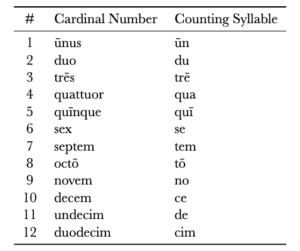
Under the auspices of Cantus Gallicorum, I designed a Latin counting system, based upon the traditional American counting system (a.k.a. the “1 E & A” counting system) that replaces the English numbers and syllables with Latin numerical syllables.
However, rather than reciting the Latin numbers entirely, this counting system isolates one unique syllable from the Latin number, which then in turn represents the number of the beat, similar to how the traditional American counting system reduces seven to sev and eleven to lev.
Having used multiple counting systems in my own experience as a student and a director. I, unfortunately, did not learn any counting system until joining choir in middle school, where the choral director implemented a counting system that I have not encountered since—a system that counts barred sixteenth notes as “one po-ta-to, two po-ta-to” and triplets as “one-la-li, two-la-li”—which seems to functionally mimic the traditional American counting system. In both high school and college, the choral directors under whom I studied generally defaulted to having us chant using neutral syllables, which is not a counting system at all. I remember having to rely heavily on the use of my pencil—typically writing rhythm slashes in my score and heavily relying upon subdivisions to ensure I was counting correctly. Foregoing the use of a counting system as a choral director entirely in favor of simply using neutral syllables (i.e., replacing the syllables of words in the text with the syllable “ta”) can easily become unethical, particularly when the choral singers are students.
As a vocalist, I am (justifiably) embarrassed to say that I contributed to the stereotype of having difficulty with counting rhythms. My ensemble directors’ failure to use counting systems did not mean I was unable to practice reciting rhythms using a counting system privately, particularly in preparation for solo sight-reading tests and juries. To be fair to my young self, when I approached my choral director for advice on improving my sight-reading skills, he handed me a PDF printout of a few hundred exercises, but provided neither the tangibility nor the curation to enable the practice of sight-reading in such a way that would improve my rhythm skills.
When I began my semester as a student teacher for a middle school (6th-8th grade), my cooperating teacher (as well as the rest of the middle school teachers in the district) functionally implemented a slightly modified version of the Kodaly counting system, with barred sixteenth notes counted as “ta-ki-ti-ki,” because some students struggled with flipping the r’s in “ti-ri-ti-ri.” Additionally, barred eighth notes were counted as “ta-ti,” because one can imagine teaching “ti-ti” to twelve year-olds not exactly going well.
This modified Kodaly system was helpful to me—the consistent use of this counting system improved my own sight-reading skills. After having spent so much time using neutral syllables in my college choral rehearsals, I finally had an epiphany—all I required was access to a solid counting system. Although this modified Kodaly system was functional for the lower-level ensembles, it would have been better to upgrade to a more sophisticated counting system in the context of advanced ensembles.
I encountered the traditional American counting system in my role as an assistant high school director at a large Texas school district, and it was quite an adjustment to move from the Kodaly system to one that demanded keeping track of numbering the exact beat, but once I familiarized myself, I saw its utility. The counting abilities of the students I worked with were also phenomenal, precisely because they possessed a solid grasp on this counting system’s use, and executed consistent rhythm drill practice.
I began writing Sight-Singing for the Choral Singer during my time in that position, and while I considered the best possible way to have choral singers count, I realized that English was itself a significant obstacle—which is frankly consistent with choral music as a whole. Take any given piece of repertoire that currently exists in English, translate it into Latin, and that piece’s Quality will already significantly improve by virtue of that one adjustment. Now, there may be some exceptions for pieces that employ text from stellar classic English-language poems, like those written by Shakespeare—or perhaps even Robert Burns—but even then, I might argue it might be best to advocate translating those works back into Scottish Gaelic).
In previous generations, American choral musicians have historically used different solfège systems as well, one of which was an English-based cardinal number system—in which 1= Do, 5= Sol, et cetera. This system largely fell out of popularity, and at the time of this writing, I remain ignorant of this system’s procedure for altered notes, but I imagine that might have been one of its major pitfalls. Conspicuously, the Latin solfège syllables returned and have completely taken over, and while there still exist a few counting systems in competition with one another, not one of these systems use Latin. The currently popular counting systems either use English-based cardinal numbers, Kodaly’s syllables, or similar variations of the two. Why has a Latin-based counting system failed to proliferate? Although I have yet to find evidence of an extant Latin-based counting system, it is highly unlikely that mine is the first one to be created. Perhaps my inability to find one is due to my own language limitations, since my Latin language proficiency is not yet at a level where I can conduct any serious research on the subject.
When working with students over the age of twelve, I highly recommend converting to the Cantus Gallicorum Latin counting system because—speaking from my own experience—this system is incredibly smooth and intuitive. Choral standard practice defaults to Latin syllables for solfège is, in part, because the Latin language does not include the obstacles that many modern languages pose for the choral ensemble. For example, diphthongs always require some sort of discussion, and when a director faces an ensemble full of members with thick Southern accents, this can become a veritable nightmare. In terms of the traditional American counting system, the English one and two is fine, but upon arriving at three, one encounters three obstacles simultaneously: th, r, and ee. Both the voiced and unvoiced th sounds require the tongue to touch the top of the back of the teeth, which blocks sound from exiting the mouth quickly and smoothly. The r sound—to be frank—will pose issues in both Latin or English—at least when leading ensembles comprised mostly of monolingual Anglophones—but combining the unvoiced th sound directly before the r sound further delays the transition from the consonant to the vowel sound. This delay might not be significant for the solo singer, but it can cause significant inefficiencies in a choral rehearsal. The ee vowel sound in English, particularly in using common words like three, tempts choral singers to easily fall into the habit of spreading the mouth so far that the overall intonation suffers, when combining counting with singing—which is already a problem in working with a soloist, but becomes excruciatingly amplified with a choral ensemble.
By reducing each word to one syllable and eliminating diphthongs, these Latin syllables significantly reduce these types of obstacles. The most difficult syllable among them would be trē because of the t sound followed by the flipped r, however, if students are unfamiliar with making this sound—which they would encounter either from studying Latin or other modern Romance languages that commonly use a flipped r like Spanish or Italian—one may simply elect to drop the r and say tē instead, just like how “three” sometimes becomes “tee” in English for counting. The syllable “cim” might also be a little bit difficult, but will be rarely used. If one encounters issues with the ch sound, the pronunciation can be switched to the Classical pronunciation rather than the Ecclesiastical pronunciation, where the letter c becomes a hard k sound. This alteration would be useful in the rare occasion that an ensemble is reciting a rhythmic passage in 12/8 at a fast tempo.
When working with students under the age of twelve, I would only recommend using something like the Kodaly system if and only if one does not have much time with those students. When I taught elementary music in east Texas, I only met with my students a maximum of 3 times per week for two weeks at a time, and then I would not see those particular classes for nearly a month until the next cycle. These class sizes were very large, and I unfortunately needed to prioritize repetition of simple topics over sophisticated systems. Under circumstances such as these, I would not recommend using the Latin-syllable counting system.
If you decide to implement the Latin counting system with your classes, ensembles, or within your own practice, please note that any feedback regarding either the advantages or flaws within this counting system would be enthusiastically welcomed.
Si vales, bene est; ego valeo